Little Ben
and the
Amber Chamber
A story about noticing — and what changes when you do.Little Ben and the Amber Chamber is a story for readers ages 8–12 about curiosity, observation, building, experimenting, and learning when to look again.Ben is the kind of kid who prefers to look twice before answering once.Throughout the story, ordinary moments become opportunities to wonder:What am I actually seeing?What changes if I move?What happens if I try it another way?And sometimes—what happens if I simply wait before deciding?

About the Book
Little Ben notices things.Not only the loud or exciting things, but the small details that are easy to pass by: how wheels turn, how light changes the feeling of a room, how people move differently when they are excited or thinking, and how something can look different when viewed from another position.Throughout Little Ben and the Amber Chamber, Ben watches, builds, tests, adjusts, and tries again.Sometimes he thinks with his hands.Sometimes he watches quietly.Sometimes an idea doesn't work quite the way he expected.And sometimes the best thing he can do is give an idea a little more time.The story doesn't present these moments as instructions or rules. They are experiences that invite readers to notice alongside Ben.
Notice. Wonder. Try.
Look Again.
Many of Ben's discoveries begin with something simple:He notices something.Then he wonders what would happen if he looked again, changed something, moved to another position, or tried a different approach.That pattern appears throughout his experiments and everyday experiences:Notice what's happening.Wonder why.Try something.Look again.Sometimes the second look reveals something the first one didn't.
Where You Stand
One of Ben and Sofia's experiments uses angled mirrors to create an image that changes depending on the viewer's position.Stand in one place and the image appears.Move slightly and it shifts.Move again and it disappears.The exhibit carries only a simple invitation:Stand here. Now move. Notice what changes.Nothing about the object itself necessarily changed.The observer did.It's one of the recurring ideas throughout Little Ben and the Amber Chamber:
sometimes understanding something differently begins simply by changing where you stand.
Two Ways of Thinking
Some children think best by wondering.Some think best by pausing.Most do both—just not always at the same time.In Little Ben and the Amber Chamber, YOO-YOO!™ gives these two familiar ways of thinking a playful shape.YOO-YOO! is a pumpkin seed—a character whose small size and potential for growth fit naturally into Ben's world of curiosity, discovery, and change.Through YOO-YOO!, two sides of thinking become easier to recognize:Curious Explorer™The part that asks:“What if?”It enjoys trying, imagining, experimenting, and discovering.Calm Thinker™The part that knows when to slow down, pause, breathe, and choose carefully.YOO-YOO! wears the Twin-Spectacles™, representing both ways of thinking.One lens reflects curiosity.The other reflects calm.The spectacles don't change the world around Ben. They offer a playful way of representing how the same situation can be approached from more than one perspective.Readers might even ask themselves:What would my Curious Explorer want to try?What would my Calm Thinker want me to notice first?Neither one always has the answer.Sometimes they work best together.And perhaps that's fitting for a little seed.Growth can begin with curiosity—and sometimes with knowing when to pause.
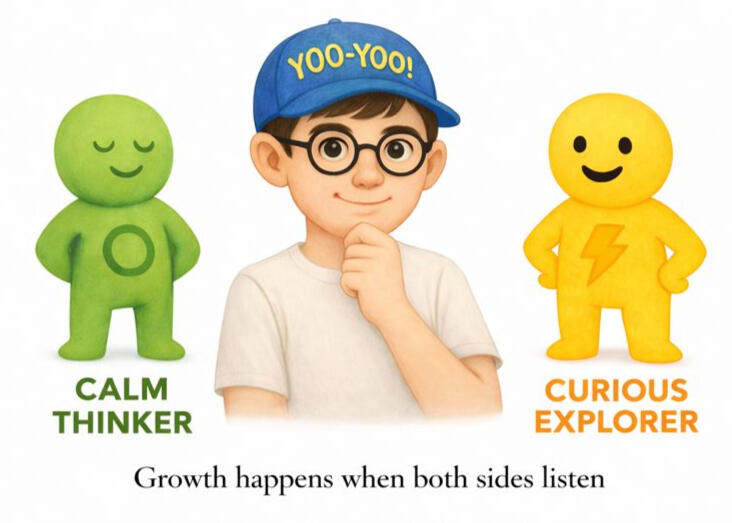

From Story to Exploration
Little Ben and the Amber Chamber is first and foremost a story.But many of Ben's experiences can also provide starting points for parents, educators, librarians, museums, and other learning spaces interested in creating their own conversations or activities around observation, perspective, experimentation, and thoughtful choices.Here are a few possibilities inspired by the story:Look AgainLet children study an object, picture, room, or exhibit.Look away.Then look again.What did they notice the second time that they missed the first?Change Where You StandChoose something that looks different from different positions.Move around it.Look from above, below, farther away, or from another side.What changed—the object, or the observer's view of it?Build. Test. Adjust.Create something simple from available materials.Instead of asking only whether it “worked,” ask:What happened?What could change?What might be worth trying next?What Happens Next?Pause during a story or scenario before the outcome is revealed.Ask:What choices are available?What might happen after each one?Would taking more time change the choice?Curious Explorer / Calm ThinkerPresent a simple situation and consider it twice.First ask:What would the Curious Explorer want to try?Then:What would the Calm Thinker want to consider first?The goal isn't necessarily to decide which one is right.The interesting part may be seeing what each perspective notices.
Make It Your Own
These are simply examples inspired by moments and ideas in the story.Parents, educators, libraries, museums, and other organizations can adapt the ideas to their own audiences, spaces, goals, and facilitation styles—or simply enjoy the book as a story.Questions Worth AskingSometimes a good activity doesn't need complicated instructions.It just needs an interesting question.What did you notice?What did you miss the first time?What changed when you moved?What happens if you try it another way?Could someone else see this differently?What would happen if you waited before deciding?What would your Curious Explorer try?What would your Calm Thinker notice?And perhaps the most Little Ben question of all:What happens if you look again?For Reading TogetherThe story can also be used simply as a conversation starter.A parent, educator, librarian, or other reader might occasionally pause at a moment in Ben's adventure and ask:“What do you think Ben will do next?”“What did Ben notice?”“Did anything change when he looked again?”“What else could he try?”“Would you have made the same choice?”There doesn't have to be a correct answer.Sometimes the conversation itself is the experiment.
More Little Ben Stories & Adventures!
Little Ben's curiosity doesn't end with the Amber Chamber.Visit the Little Ben Stories & Adventures section to discover more books, stories, and adventures from Little Ben's world.Each story explores a different experience while carrying forward the curiosity, imagination, experimentation, and habit of noticing that define Little Ben.
© 2025 Little Ben and the Amber Chamber. All rights reserved.
More Little Ben Stories & Adventures!
Coming Soon!

BEN AND THE MEMORY PALACE
Recommended ages: 13-17+
One wrong turn. One impossible journey.Fifteen-year-old Ben thought his biggest problem was preparing for Monday's chemistry exam.
But when the hallway lights begin to flicker and a familiar voice calls his name, Ben and his friend Sofia follow the voice to an elevator that transports them into another dimension. There, they discover a mysterious world unlike anything they've ever imagined.
Before long, they find themselves navigating a vast labyrinth of strange territories, hidden passages, and puzzling landmarks, where the elements of the periodic table hold the clues to their next destination.
As they venture deeper, every discovery raises new questions. Ben and Sofia must solve puzzles, overcome obstacles, and correct wrong turns as they struggle to understand the rules of a world that seems determined to keep its secrets.Some adventures are impossible to forget.